
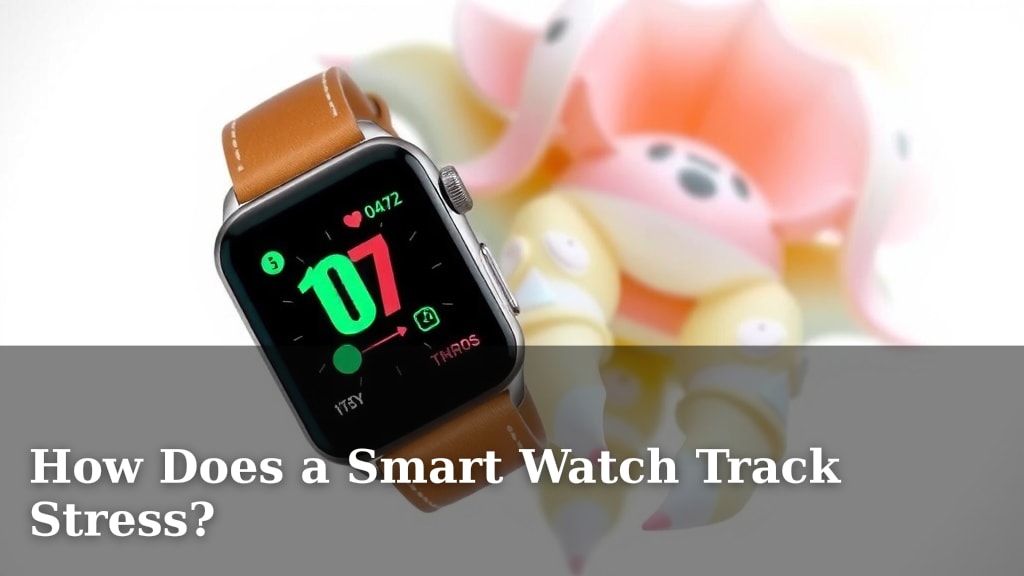
How Does a Smart Watch Track Stress?
Your smartwatch tracks stress by monitoring your body’s physical responses to mental or emotional strain. It looks for changes in your heart rate variability (HRV) and skin conductivity. These are key indicators that your body is reacting to stress. It’s like having a tiny detective on your wrist.
This technology uses sensors to gather data, which is then analyzed by algorithms. These algorithms are trained to detect patterns associated with stress. They look at how your heartbeat speeds up or slows down. They also check how your skin’s electrical properties change.
- Smartwatches use sensors to measure physical stress signals.
- Heart rate variability (HRV) is a major factor.
- Skin conductivity also plays a role.
- Algorithms analyze this data for stress patterns.
- It helps you understand your body’s reactions.
Ready to learn more about how your watch becomes your personal stress meter? Let’s dive into the science behind it.
How Your Smartwatch Becomes Your Personal Stress Detector
You might be wondering how that little device on your wrist can actually tell if you’re stressed. It’s not magic; it’s science! Your smartwatch uses its built-in sensors to pick up on subtle physical changes your body makes when you’re under pressure. Think of it as your body’s silent signals being translated into data you can understand.
These signals are your body’s automatic responses to stress, known as the “fight or flight” response. Even if you’re not running from a tiger, your body can react as if you are. Your smartwatch is designed to notice these reactions. It then uses clever algorithms to interpret what these changes might mean. This helps you get a clearer picture of your stress levels throughout the day.
The Heart of the Matter: Heart Rate Variability (HRV)
One of the most important signals your smartwatch looks for is Heart Rate Variability (HRV). You might think your heart beats like a steady drum, but it’s actually more like a dynamic rhythm section. The time between each heartbeat isn’t perfectly consistent.
HRV measures these tiny variations in the timing of your heartbeats. When you’re calm and relaxed, your heart rate variability is typically higher. This means there’s more variation between your beats. It suggests your body’s systems are balanced and flexible. Your autonomic nervous system, which controls involuntary actions like your heartbeat, is likely in a parasympathetic state, also known as “rest and digest.”
On the flip side, when you’re stressed, your heart rate often speeds up. However, the variation between your heartbeats usually decreases. This lower HRV can indicate that your sympathetic nervous system, the “fight or flight” system, is taking over. Your body is getting ready to react to a perceived threat. Many health experts use HRV as a key indicator of overall health and stress levels (American Heart Association).
Feeling It on Your Skin: Electrodermal Activity (EDA)
Ever notice your palms get a little sweaty when you’re nervous? Your smartwatch can pick up on that too, in a way! This is measured through something called Electrodermal Activity (EDA), sometimes referred to as Galvanic Skin Response (GSR).
EDA sensors measure the electrical properties of your skin. When you experience stress or strong emotions, your sweat glands become more active. Even a small increase in sweat can change the way your skin conducts electricity. Your smartwatch detects these slight shifts in conductivity. A higher skin conductivity can be another sign that your body is reacting to stress.
It’s like your skin is providing a little extra feedback. When your sympathetic nervous system is activated by stress, it triggers these sweat glands. This makes your skin a better conductor of electricity. The smartwatch’s sensors are sensitive enough to notice these subtle changes. This data, combined with HRV, gives a more complete picture of your body’s stress response.
How the Watch Puts It All Together
So, your watch is collecting all this data: your heart rate changes, the variability between beats, and your skin’s electrical signals. But how does it know if it’s stress or just a really good workout?
The Role of Algorithms
This is where the smart algorithms come into play. These are sophisticated sets of instructions programmed into your watch’s software. They are designed to analyze the data streams from your sensors.
These algorithms have been trained on vast amounts of data. They learn to identify patterns. They learn what a high-stress response looks like compared to a relaxed state or physical exertion. They look for trends over time. For example, a sudden spike in heart rate combined with decreased HRV and increased skin conductivity is a strong indicator of stress.
It’s important to remember that these algorithms are constantly learning and improving. Software updates often refine how your watch interprets your body’s signals. They aim to make the stress tracking more accurate for you personally.
Personalizing Your Stress Tracking
Your smartwatch doesn’t just have one fixed idea of what stress looks like. It aims to learn your unique baseline. Your normal heart rate and HRV when you’re feeling calm are established over time.
When your body deviates significantly from this personal baseline, especially in ways associated with stress, the watch flags it. This personalization makes the stress tracking more relevant to your individual physiology. What might be a stressful event for you might be a minor blip for someone else. Your watch tries to account for that.
Understanding Your Stress Data
Once your smartwatch has collected and analyzed this information, it presents it to you in an understandable format. This might be through a stress score, a graph, or notifications.
Here’s a quick look at what your watch might be tracking:
- Heart Rate: How fast your heart is beating.
- Heart Rate Variability (HRV): The subtle changes in time between heartbeats.
- Skin Conductance: How easily electricity passes through your skin, related to sweat.
- Sleep Quality: How well you’re resting, which heavily impacts stress.
- Activity Levels: Your daily movement, which also influences stress.
Seeing this data can be incredibly helpful. It allows you to identify triggers. You might notice that certain situations or times of day consistently lead to higher stress readings. This awareness is the first step toward managing stress better. You can then make conscious choices to de-stress.
What Your Smartwatch Offers You
Your smartwatch acts as a continuous monitoring tool. It doesn’t just measure stress once; it tracks it over hours, days, and even weeks. This long-term view is powerful.
It helps you see patterns you might otherwise miss. Are you more stressed on workdays? Does a lack of sleep consistently show up as higher stress the next day? This information is gold for making lifestyle adjustments. For instance, you might decide to prioritize sleep or incorporate short mindfulness breaks into your workday. Many health professionals suggest tracking stress alongside other health metrics to get a fuller picture (CDC).
Think of your smartwatch as a helpful coach. It’s not judging you; it’s simply reporting on your body’s signals. By understanding how it works, you can better use the information it provides to take care of yourself.
| Sensor | What it Measures | How it Relates to Stress |
|---|---|---|
| Optical Heart Sensor | Heart Rate | Higher heart rate can signal the ‘fight or flight’ response. |
| N/A (Calculated) | Heart Rate Variability (HRV) | Lower HRV often indicates increased stress or sympathetic nervous system activation. |
| EDA Sensor | Skin Conductance | Increased sweat due to stress changes skin’s electrical properties. |
Conclusion
Your smartwatch uses advanced sensors to monitor your body’s stress signals. By tracking changes in Heart Rate Variability (HRV) and skin conductivity, it offers a window into your physiological responses. Clever algorithms analyze this data, learning your personal baseline to identify potential stress triggers. Understanding these readings is your first step toward better stress management. Use this information to make informed choices and prioritize your well-being. Take that first step today by reviewing your stress data.
Frequently Asked Questions
Can my smartwatch detect stress accurately?
Smartwatches are designed to detect stress by looking at physiological signs like heart rate variability and skin conductivity. While they are good at identifying patterns associated with stress, they are not medical devices. Always consult a healthcare professional for any health concerns.
Why is Heart Rate Variability (HRV) so important for stress tracking?
HRV measures the tiny variations between your heartbeats. A higher HRV generally indicates a relaxed state, while a lower HRV often signals that your body is in a stress response mode. It’s a key indicator of your autonomic nervous system’s balance.
How does skin conductivity relate to stress?
When you’re stressed, your body can produce more sweat, even if it’s not noticeable. This sweat increases the electrical conductivity of your skin. Your smartwatch’s sensors can detect these subtle changes, adding another layer of data to its stress assessment.
Will my smartwatch tell me exactly what is causing my stress?
No, your smartwatch identifies physiological signs of stress but doesn’t know the specific cause. It helps you notice when your body is stressed, allowing you to reflect on your situation and identify personal triggers yourself. Awareness is key to managing stress.
Can physical activity affect my smartwatch’s stress readings?
Yes, intense physical activity can also influence your heart rate and HRV, sometimes mimicking stress signals. Smartwatches use algorithms to try and differentiate between stress and exercise, but it’s good to be aware of your activity levels when interpreting your stress data.
![7 Best Gps Tracker Smart Watch [2026]](https://smartwatchbest.com/wp-content/uploads/2026/08/7-best-gps-tracker-smart-watch-2026-featured-768x432.jpg)
![7 Best Smart Watch Bands [2026]](https://smartwatchbest.com/wp-content/uploads/2026/08/7-best-smart-watch-bands-2026-featured-768x432.jpg)
![7 Best Smart Watch For Small Wrist Men [2026]](https://smartwatchbest.com/wp-content/uploads/2026/09/7-best-smart-watch-for-small-wrist-men-2026-featured-768x432.jpg)