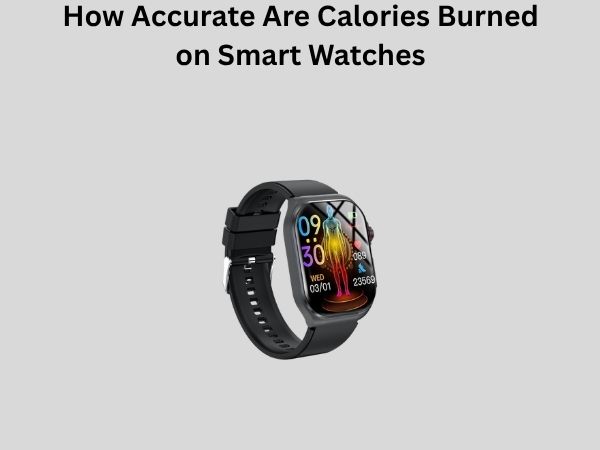
How Accurate Are Calories Burned on Smart Watches? Don’t Be Fooled!
We’ve all been there. You strap on your shiny new smartwatch, go for a run, and it tells you that you’ve burned 500 calories. You feel great, thinking you’ve earned that extra slice of pizza later. But here’s the thing—that number might be more fiction than fact.
In this article, I’m going to walk you through the real truth about calorie tracking on smartwatches. Are they accurate? Sometimes. Are they wildly off? Absolutely. Let’s dig into what’s actually happening on your wrist and why these devices often get it wrong.
Understanding How Smartwatches Calculate Calories
Let me start with the basics. When you wear a smartwatch and exercise, it’s trying to answer a complex question: how much energy are you actually burning? This is harder than it sounds because your body is incredibly complicated.
Think of it this way—your smartwatch is like someone trying to guess your weight by looking at you from across the room. They might get close, but there’s going to be some error involved.
The Heart Rate Connection
Most smartwatches rely heavily on your heart rate data. When your heart beats faster, the device assumes you’re working harder and therefore burning more calories. This seems logical, right? Higher heart rate equals more effort equals more calories burned.
But here’s where it gets tricky. Your heart rate is influenced by so many things. Maybe you’re stressed about a work deadline—your heart rate goes up, but you’re sitting at your desk. Or perhaps you’ve had too much caffeine. Suddenly, your smartwatch thinks you’re burning calories when you’re really just jittery.
The Resting Metabolic Rate Factor
Your smartwatch also tries to factor in your resting metabolic rate—the calories your body burns just by existing. This is where personal information comes in. When you set up your device, you enter your age, weight, height, and gender. The watch uses this to estimate how many calories you burn at rest.
The problem? Everyone’s metabolism is different. Two people with identical stats might have completely different metabolic rates. One person might have a sluggish metabolism due to genetics, while another might have a lightning-fast one. Your smartwatch can’t know this without a lab test.
The Technology Behind the Scenes
Accelerometers and Movement Tracking
Beyond heart rate, smartwatches use accelerometers to detect movement. These sensors measure motion in three dimensions and try to figure out what activity you’re doing. Are you walking? Running? Cycling? The watch tries to categorize your movement and adjust calorie calculations accordingly.
This technology is pretty impressive, but it’s not perfect. If you’re pushing a shopping cart, the accelerometer might think you’re doing light walking. But the actual effort you’re expending could be quite different. The watch can’t really tell the difference.
GPS and Elevation Data
Many smartwatches include GPS, which helps track your route and elevation changes. This is useful because running uphill burns more calories than running on flat ground. Your watch can factor this in.
However, GPS data isn’t always accurate either. In urban areas with tall buildings, the GPS signal can bounce around, giving false elevation readings. This can skew your calorie calculations.
Why Accuracy Varies So Much Between Devices
If you compare calorie readings across different smartwatch brands, you might notice they’re all over the place. Why is this happening?
Different Algorithms and Formulas
Each smartwatch manufacturer uses their own proprietary algorithm to calculate calories. There’s no universal standard. Apple uses one formula, Fitbit uses another, Garmin uses yet another. These companies don’t always share exactly how their calculations work, so we can’t always know why they differ.
It’s like having five different weather forecasters in your town—they all have access to the same data, but they interpret it differently and come up with different predictions.
Varying Sensor Quality
Not all smartwatches have the same sensors. Some have fancy optical heart rate monitors, while others use less sophisticated technology. Some include GPS, others rely on your phone’s GPS. These differences directly impact accuracy.
A watch with a top-tier heart rate sensor will likely give you more reliable readings than one with a basic sensor. But you’re also paying a premium for that accuracy.
Software Updates and Machine Learning
The good news is that smartwatch companies are constantly working to improve their algorithms through machine learning. They collect data from millions of users and use it to refine their formulas. Over time, the calculations often get more accurate.
This means a smartwatch you bought a few years ago might actually get more accurate as it receives software updates. It’s learning from the collective experiences of all its users.
Common Factors That Throw Off the Numbers
Individual Differences in Metabolism
As I mentioned earlier, everyone’s metabolism is unique. Factors like muscle mass, age, gender, genetics, and even gut bacteria affect how many calories you burn. Your smartwatch can’t account for all these individual variations.
If you have more muscle mass than average, you’re burning more calories than the generic formula suggests. If you have less muscle, you’re burning fewer. The watch doesn’t know your actual body composition.
Weather and Environmental Conditions
Did you know that exercising in cold weather burns more calories? Your body has to work harder to maintain its temperature. But does your smartwatch know it’s 30 degrees outside? Not really. It might use weather data if it’s connected to your phone, but it doesn’t account for wind, humidity, or how your body is responding to these conditions.
Fitness Level and Training Adaptations
As you get fitter, your body becomes more efficient at exercise. That means you burn fewer calories doing the same activity. Your smartwatch might not account for your increasing fitness level. It could be overestimating your calorie burn as you improve.
Activity Type and Intensity Variations
Here’s something that frustrates many users: smartwatches struggle with non-traditional workouts. If you’re doing strength training with lots of rest periods, your heart rate might be elevated, but you’re not continuously burning high calories. The watch might overestimate.
Similarly, activities like yoga or pilates might show lower calorie burns than you actually achieved because your heart rate isn’t elevated, even though you’re working hard.
Comparing Major Smartwatch Brands and Their Accuracy
Apple Watch
Apple Watch tends to be on the higher end of accuracy, particularly for running and walking. Studies have shown it’s reasonably reliable for measuring heart rate, which is a key component of calorie calculation. However, it still tends to overestimate calorie burn for many users.
The newer Apple Watch models with improved sensors show better performance, but they’re still not perfect.
Fitbit Devices
Fitbit has been in the fitness tracking game for a long time, and it shows. Their algorithms are relatively mature. That said, many users report that Fitbit either significantly overestimates or underestimates calories depending on the activity type.
Fitbit’s strength is in consistent tracking over time. Even if the absolute numbers are off, the relative comparisons between different workouts tend to be fairly reliable.
Garmin Watches
Garmin is popular among serious athletes, and for good reason. Their devices tend to provide more accurate estimates, especially for sports-specific activities. The company invests heavily in sensor technology and algorithm development.
That said, Garmin devices are also more expensive, and even their high-end models aren’t perfectly accurate.
Wear OS and Generic Smartwatches
Budget smartwatches and those running Google’s Wear OS platform tend to be less accurate. They often use simpler algorithms and less sophisticated sensors. If you’re considering a cheaper option, be aware that accuracy will likely suffer.
What Scientific Research Says About Smartwatch Accuracy
I don’t want to just give you my opinions here. Let’s look at what actual science tells us.
Research Study Findings
Multiple peer-reviewed studies have examined smartwatch accuracy for calorie tracking. The results are sobering. Most studies find that smartwatches overestimate calorie burn by 10 to 40 percent on average.
One study published in the Journal of Personalized Medicine compared several popular smartwatches against a gold-standard measurement method. Nearly all of them significantly overestimated the calories burned during various activities.
The Gold Standard Comparison
Scientists use indirect calorimetry as a gold standard for measuring actual energy expenditure. This involves analyzing your oxygen consumption and carbon dioxide production. It’s accurate but impractical for everyday use.
When smartwatches are compared to this gold standard, the differences can be striking. A watch might say you burned 300 calories when the actual measurement shows 200.
Activity-Specific Accuracy
Interestingly, smartwatches are generally more accurate for steady-state cardio activities like running and cycling. They’re less accurate for strength training, sports with irregular movement patterns, and low-intensity activities.
This makes sense because the algorithms are optimized for the kinds of workouts that generate clear patterns in the data.
Tips for Getting More Reliable Calorie Data
Use Consistent Activity Labels
Always specify what activity you’re doing when you start a workout. Don’t just let the watch guess. If you tell it you’re cycling, it will use the cycling formula. If you let it auto-detect, it might get confused.
Keep Your Profile Information Updated
Make sure your height, weight, and age are current in your smartwatch app. These are fundamental inputs to the calorie calculation. Outdated information directly impacts accuracy.
Ensure Proper Heart Rate Monitor Fit
For optical heart rate monitors on smartwatches, a proper fit is crucial. The watch needs to make good contact with your skin. Wear it snugly but not so tight that it cuts off circulation. Clean the sensors regularly, as dirt or sweat buildup can interfere with readings.
Account for Overestimation
Based on research, consider that your smartwatch might be overestimating by 20 to 30 percent. If it says you burned 400 calories, the actual number might be closer to 300. You might want to factor this in when thinking about your calorie balance.
Look for Trends, Not Absolute Numbers
Rather than obsessing over the exact calorie count, use your smartwatch data to track trends over time. If you ran the same route last week and burned 280 calories, and today you burned 290 calories, that relative difference is meaningful. It suggests you worked slightly harder or are getting faster.
Alternative Methods for Tracking Calories Burned
Laboratory Testing
If you really want accuracy, you can have indirect calorimetry or a VO2 max test done at a sports medicine clinic or university lab. This is expensive and not practical for everyday use, but it gives you a baseline for your personal calorie expenditure.
Heart Rate Reserve Method
You can calculate calories burned using your heart rate reserve, which is based on your maximum heart rate and resting heart rate. This requires a bit of math, but it’s more personalized than what a generic algorithm provides.
Established Formulas and Equations
Fitness professionals often use formulas like the Karvonen formula or METs (Metabolic Equivalent of Task) to estimate calories. These provide a more scientific approach than what your smartwatch offers, though they still have limitations.
Professional Coaching and Guidance
A personal trainer or sports nutritionist can help you understand your actual calorie expenditure based on your specific fitness level, body composition, and training style. This is more expensive but very accurate.
The Future of Smartwatch Accuracy
Advancing Sensor Technology
Smartwatch manufacturers are investing in better sensors. We’re seeing improvements in optical heart rate monitors, and some companies are exploring additional sensors that could help measure other variables affecting calorie burn.
As sensors become more sophisticated, the data quality will improve, leading to better algorithms and more accurate estimates.
Artificial Intelligence and Machine Learning
AI and machine learning are revolutionizing how smartwatches process data. By analyzing patterns from millions of users, companies can train algorithms that become increasingly accurate over time.
Imagine a smartwatch that learns your personal calorie expenditure patterns and adjusts its estimates based on your individual metabolism. This is becoming more possible as AI technology advances.
Integration with Other Health Data
Future smartwatches might integrate with genetic testing, detailed body composition analysis, and other health markers to create a more complete picture of your individual calorie expenditure. This would be far more accurate than current methods.
Wearable Technology Standards
There’s growing interest in establishing industry standards for calorie tracking. If manufacturers agreed on methodology and testing protocols, it would be easier to compare devices and for consumers to understand what they’re getting.
Should You Trust Your Smartwatch Calorie Data?
So here’s the bottom line: should you trust the calorie numbers your smartwatch is showing you?
The answer is nuanced. For general motivation and tracking trends over time, absolutely. Your smartwatch is a great tool for seeing whether you’re becoming more active and fit. It can motivate you to move more and stay consistent with your workouts.
But if you’re making important decisions based on the absolute calorie numbers—like how much you can eat after a workout—you should be skeptical. The numbers are often inflated.
Conclusion
Smartwatches have revolutionized how we think about fitness and activity tracking. They’re genuinely useful tools that can help you stay motivated and aware of your habits. However, when it comes to calorie tracking specifically, accuracy leaves something to be desired.
The reality is that calculating actual calorie expenditure is incredibly complex. Your smartwatch is making educated guesses based on limited data. It doesn’t know your exact metabolism, your muscle mass, or how your body specifically responds to exercise.
Most smartwatches overestimate calorie burn by 10 to 40 percent. Some brands are more accurate than others, but none are perfect. This doesn’t mean you should abandon your smartwatch—just use it with realistic expectations.
Focus on using your smartwatch to track trends,
![7 Best Lightweight Smart Watch [2026]](https://smartwatchbest.com/wp-content/uploads/2026/08/7-best-lightweight-smart-watch-2026-featured-768x432.jpg)