
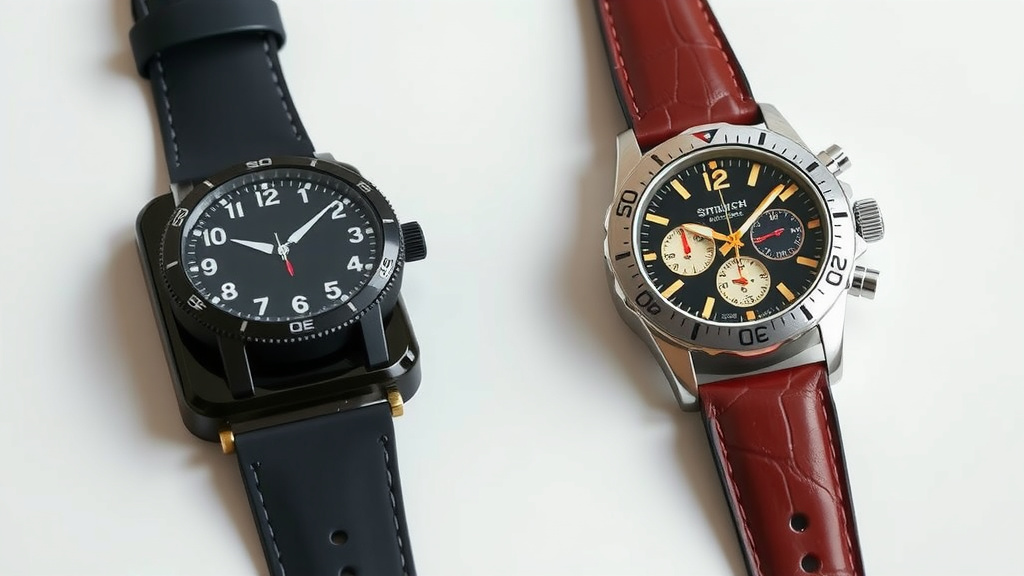
Smartwatch vs Traditional Watch: Which Is Right for You
When comparing smart watches vs traditional watches, the best choice really depends on what you need your watch to do. A smartwatch offers advanced features like fitness tracking and notifications, while a traditional watch focuses on telling time with classic style and often greater durability. You don’t have to pick just one; many people use both!
Think about your daily routine and priorities. Do you want a device that keeps you connected and informed on the go? Or do you prefer a timepiece that’s a statement piece, perhaps with a rich history or mechanical wonder? We found that both types of watches serve distinct purposes, and understanding these differences helps you make the right decision for your wrist.
- Smartwatches offer tech features; traditional watches offer classic style.
- Consider what you value most: connectivity or timeless design.
- Smartwatches track fitness and provide notifications.
- Traditional watches are often durable and can be heirlooms.
- The “better” watch depends entirely on your personal needs.
Below, we’ll walk you through the pros and cons of each, helping you decide which type of watch is the perfect fit for your lifestyle.
“`htmlSmart Watches vs. Traditional Timepieces: What’s Your Wrist’s Calling?
Choosing between a smartwatch and a traditional watch feels like a modern dilemma, doesn’t it? You want something functional, stylish, and perhaps even a conversation starter. We found that both types of watches excel in different areas. A smartwatch is like a mini-computer on your wrist, packed with tech. A traditional watch is a classic piece, often celebrated for its craftsmanship and enduring style. The biggest difference boils down to what you want your watch to do for you.
The Smartwatch Experience: More Than Just Telling Time
When you strap on a smartwatch, you’re embracing a connected lifestyle. These devices are built for the modern, on-the-go individual. They offer a wealth of features that extend far beyond simply displaying the hour.
Fitness and Health Tracking Capabilities
One of the biggest draws of smartwatches is their ability to monitor your health. You can track your daily steps, heart rate, calories burned, and even sleep patterns. Many smartwatches can guide you through workouts, providing real-time feedback. Some even offer features like ECG (electrocardiogram) readings and blood oxygen monitoring, giving you deeper insights into your well-being. Research suggests that using fitness trackers can lead to increased physical activity and improved health outcomes (CDC).
Staying Connected and Informed
Never miss an important alert again. Your smartwatch can display notifications from your smartphone directly on your wrist. This means you can see incoming calls, text messages, and app alerts without needing to pull out your phone. This is incredibly useful when you’re in a meeting, exercising, or just want to keep your phone tucked away. It helps you stay connected without being constantly distracted.
Convenience Features at Your Fingertips
Beyond notifications, smartwatches offer many conveniences. You can often make contactless payments using services like Apple Pay or Google Pay. Some allow you to control your music, check the weather, or even use voice assistants like Siri or Google Assistant. You can also customize the watch face to suit your mood or outfit, offering a unique personalization option.
Potential Downsides of Smartwatches
However, smartwatches do have their trade-offs. Their battery life is often a concern. Most require daily charging, which can be a hassle for some users. They can also be more fragile than traditional watches, and a damaged screen might be costly to repair. Furthermore, the constant stream of notifications can sometimes feel overwhelming, leading to digital fatigue. Think about whether you want that constant connectivity or if it might become a source of stress.
The Allure of the Traditional Watch: Timeless Elegance and Craftsmanship
Traditional watches, on the other hand, represent a different philosophy. They are often cherished for their heritage, craftsmanship, and aesthetic appeal. While they might not send you text messages, they offer their own unique set of advantages.
Enduring Style and Sophistication
A traditional watch is a statement piece. It’s an accessory that speaks volumes about your personal style. From sleek minimalist designs to robust dive watches, there’s a traditional watch for every taste. Many people appreciate the mechanical artistry involved in high-end timepieces, like automatic or manual wind movements. These watches are designed to last, often becoming heirlooms passed down through generations. They don’t rely on software updates or charging cables; they simply keep ticking.
Durability and Longevity
Many traditional watches are built with robust materials and designed for longevity. They often feature scratch-resistant sapphire crystals and water-resistant cases, making them suitable for demanding environments. Unlike smartwatches that can become obsolete with new models, a well-made traditional watch can remain functional and stylish for decades. This makes them a sustainable choice in the long run.
Simplicity and Reliability
There’s a certain peace in the simplicity of a traditional watch. Its primary function is to tell time, and it does that exceptionally well. You don’t have to worry about battery life diminishing or software glitches. The reliability of a good mechanical or quartz movement is something many watch enthusiasts deeply value. It’s a tool you can count on, day in and day out, without needing a recharge.
Potential Drawbacks of Traditional Watches
Of course, traditional watches aren’t for everyone. Their core functionality is limited to timekeeping and perhaps date display. If you’re looking for advanced health tracking or smart notifications, a traditional watch won’t suffice. Also, high-quality traditional watches can be a significant investment, with luxury timepieces costing thousands or even tens of thousands of dollars.
Making Your Choice: A Quick Comparison
To help you decide, let’s look at how they stack up side-by-side. Think about what matters most to you in a daily accessory.
| Feature | Smartwatch | Traditional Watch |
|---|---|---|
| Primary Function | Connectivity, notifications, apps, health tracking | Telling time, style, craftsmanship |
| Battery Life | Daily charging often required | Years (quartz) or self-winding (automatic) |
| Durability | Can be more fragile, screen susceptible to damage | Often very durable, built to last |
| Connectivity | Connects to smartphone, Wi-Fi, Bluetooth | None |
| Cost | Varies widely, but feature-rich models can be expensive | Varies widely, from affordable to very high luxury |
| Style Customization | High (digital watch faces) | Moderate (strap changes, dial variations) |
Your Wrist, Your Priorities: A Checklist
Ask yourself these quick questions to help clarify your needs:
- Do you want to track your workouts automatically?
- Is receiving phone notifications on your wrist important?
- Do you prefer a device that needs daily charging?
- Is timeless design and heirloom potential a priority?
- Do you value simplicity and long-term reliability over tech features?
- Does your budget lean towards a tech gadget or a classic accessory?
Conclusion
Ultimately, the choice between a smartwatch and a traditional watch comes down to your personal priorities and lifestyle. If you crave connectivity, fitness tracking, and the convenience of smartphone alerts on your wrist, a smartwatch is likely your best bet. Conversely, if you value timeless style, mechanical artistry, and enduring durability without the need for daily charging, a traditional watch might be your perfect companion. You don’t have to choose just one; many find joy in wearing both for different occasions. Consider what you want your watch to do for you and make the decision that best fits your daily needs and personal taste.
Frequently Asked Questions
Can a smartwatch truly replace a traditional watch?
For many, a smartwatch can replace a traditional watch if its advanced features like notifications and fitness tracking are what you prioritize. However, if you value the aesthetic, heritage, or mechanical nature of traditional timepieces, a smartwatch may not offer the same sentimental or stylistic appeal.
Are traditional watches still relevant in the age of smartwatches?
Yes, traditional watches remain highly relevant. They are often seen as fashion accessories, heirمنیpieces, and symbols of craftsmanship. Their enduring style and reliability appeal to those who prefer less technology and more classic design on their wrist.
Which type of watch is better for fitness tracking?
Smartwatches are generally better for fitness tracking. They come equipped with sensors for heart rate, steps, sleep, and various workout modes, often integrating with fitness apps for detailed analysis.
How do battery lives compare between smartwatches and traditional watches?
Smartwatches typically require charging daily or every few days, depending on usage. Traditional quartz watches can last for years on a single battery, while automatic or mechanical watches rely on movement to stay wound, meaning they don’t need batteries at all.
Is it more expensive to buy a smartwatch or a traditional watch?
Both types of watches have a wide price range. Entry-level smartwatches can be more affordable than mid-range traditional watches. However, high-end luxury smartwatches and premium traditional timepieces can both cost thousands of dollars.

![7 Best Smart Watch For Firefighters [2026]](https://smartwatchbest.com/wp-content/uploads/2026/08/7-best-smart-watch-for-firefighters-2026-featured-768x432.jpg)

![7 Best Smart Watch For Cardio [2026]](https://smartwatchbest.com/wp-content/uploads/2026/08/7-best-smart-watch-for-cardio-2026-featured-768x432.jpg)