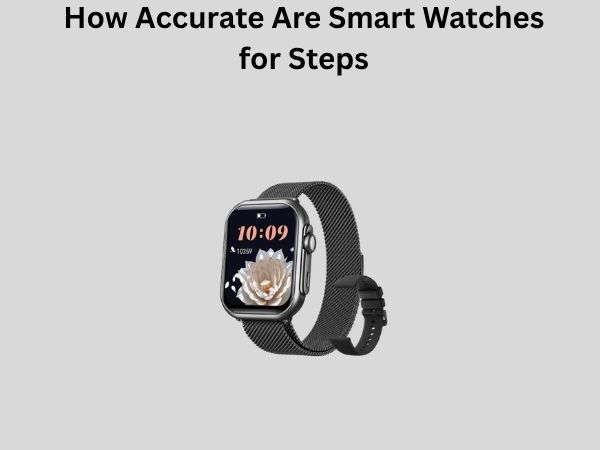
How Accurate Are Smart Watches for Steps? A Comprehensive Guide to Step Counting Accuracy
Have you ever wondered if your smartwatch is actually counting your steps correctly? You strap on that sleek device every morning, and by evening, it tells you’ve walked 10,000 steps. But is that number real, or is your wrist-worn companion playing fast and loose with the facts? Let me dive deep into this question that’s probably crossed your mind more than once.
Understanding the Basics: What Makes Step Counting So Tricky?
Think of your smartwatch as a tiny detective strapped to your wrist. It’s got sensors—accelerometers and gyroscopes—that detect motion patterns. These sensors pick up vibrations and movements that your watch interprets as steps. But here’s the thing: not all motion is equal. Sometimes your arm swings differently. Sometimes you’re pushing a shopping cart. Sometimes you’re just gesturing wildly while talking on the phone. Your smartwatch has to distinguish between genuine walking and false positives, which is harder than it sounds.
The challenge lies in the fact that every person walks differently. Your gait—the way you walk—is as unique as your fingerprint. Some people take long strides, others take shorter, quicker steps. Some people swing their arms vigorously, while others barely move them. This variability makes it incredibly difficult for smartwatch manufacturers to create a universal algorithm that works perfectly for everyone.
The Science Behind Smartwatch Step Counting
How Accelerometers Detect Movement
At the heart of every smartwatch’s step-counting capability is the accelerometer. This tiny chip measures acceleration in three dimensions—up and down, left and right, and forward and backward. When you walk, your wrist experiences repetitive up-and-down motion with each step. The accelerometer detects this pattern and sends data to the watch’s processor.
The processor then runs an algorithm—basically a set of instructions—that analyzes these motion patterns. It looks for rhythmic movements that match the characteristics of normal walking. If the pattern matches, the watch registers a step. If it doesn’t, the step gets ignored. Simple in theory, but incredibly complex in practice.
The Role of Machine Learning
Modern smartwatches don’t rely solely on basic accelerometer data anymore. Many brands now use machine learning, which means the watch actually learns from your personal walking patterns over time. It’s like training a dog—the more data it collects about how you specifically walk, the better it gets at recognizing your unique gait.
Smartwatches from brands like Apple, Fitbit, and Garmin continuously gather information. They learn whether you tend to take long strides or shuffle your feet. They figure out how much you typically swing your arms. This personalized approach makes these devices increasingly accurate the longer you wear them.
What Do the Studies Actually Show?
Accuracy Varies Dramatically by Brand
Here’s where things get interesting. Research studies on smartwatch accuracy paint a mixed picture. Some watches perform remarkably well, while others fall short. One major finding across multiple studies is that accuracy tends to vary significantly depending on the brand and model you’re using.
For instance, high-end smartwatches from premium brands often outperform budget options. This makes sense—more sophisticated sensors, better algorithms, and more research investment generally translate to improved performance. But price doesn’t guarantee accuracy; it’s really about the technology inside.
The Range of Accuracy Rates
Studies have found that smartwatches can be anywhere from 95 percent accurate to as low as 70 percent accurate, depending on various factors. That’s a huge range. Think about it: if your watch says you walked 10,000 steps, you might have actually walked anywhere from 7,000 to 10,500 steps. That’s a meaningful difference if you’re trying to hit specific fitness goals.
Most mainstream smartwatches tend to cluster around 90 to 95 percent accuracy under normal walking conditions. But that accuracy drops when conditions get unusual. When you’re walking very slowly, very quickly, or on an incline, the accuracy tends to decrease. Some studies suggest that older individuals experience lower accuracy rates than younger people, possibly due to changes in gait that come with age.
Factors That Impact Smartwatch Step Accuracy
Walking Speed and Gait Variations
One of the biggest factors affecting accuracy is how fast or slow you’re walking. Most smartwatches are calibrated for “normal” walking speeds—roughly 3 to 4 miles per hour. When you deviate significantly from this, the accuracy suffers.
If you’re a leisurely stroller who loves to meander through parks, your watch might undercount your steps. Conversely, if you’re a power-walker moving at a brisk clip, your watch might overcount slightly. It’s like the watch is tuned to expect a certain rhythm, and when you throw off that rhythm, it gets confused.
Environmental Factors and Terrain
The ground beneath your feet matters more than you’d think. Walking on flat, smooth surfaces like a treadmill produces the most accurate step counts. But what happens when you’re hiking on uneven terrain? Or walking on a beach where your feet sink slightly with each step? The variability increases dramatically.
Studies have shown that smartwatches are generally less accurate on inclines and declines compared to flat surfaces. Climbing stairs, for example, can confuse the accelerometer because the movement pattern differs from regular walking. The vertical component becomes much more prominent, which throws off the algorithm’s calculations.
Your Arm Positioning and Movement
Here’s something many people don’t think about: where your smartwatch is positioned on your wrist and how much you move your arms affects counting accuracy. If you wear your watch loosely, it might bounce around more, potentially registering false steps. If you wear it tightly, it moves more in sync with your actual arm movement.
Also, if you’re not swinging your arms while walking—maybe you’re pushing a shopping cart or holding a child—the watch’s accelerometer gets less clear data about your movement, which can reduce accuracy. Some people naturally swing their arms more than others, and this personal variation affects how well the watch performs for them specifically.
Age and Physical Condition
Your age and overall fitness level play a role too. Younger, more active individuals often get more accurate step counts because their gait is more consistent and pronounced. Older adults or those with mobility issues might experience lower accuracy because their walking patterns are different.
Interestingly, people with certain medical conditions that affect gait—like arthritis or Parkinson’s disease—often experience less accurate step counts. It’s not that the smartwatch is “broken”; it’s just that these watches are primarily designed and tested on a population with standard gait patterns.
Smartwatch Accuracy in Different Scenarios
Treadmill vs. Outdoor Walking
Treadmill walking produces remarkably accurate step counts—sometimes near-perfect accuracy. Why? Because the movement is very repetitive and consistent. The treadmill provides a predictable rhythm that smartwatch algorithms handle beautifully.
Outdoor walking is another story. Real-world conditions introduce variables—uneven pavement, varying terrain, outdoor distractions that change your pace. Your smartwatch has to work harder to filter out noise and identify true steps. This is where we typically see accuracy drop from 95 percent to perhaps 85 to 90 percent in real-world scenarios.
Stair Climbing and Inclines
Climbing stairs is notoriously difficult for smartwatches. The vertical component of stair climbing creates a different acceleration pattern than flat-ground walking. Many watches undercount stairs because the algorithm doesn’t recognize the unique pattern.
Some advanced smartwatches with barometric altimeters can detect elevation changes and adjust their calculations accordingly. These models often perform better on inclines and stairs. But standard accelerometer-only models struggle with vertical movement, which is why your watch might show fewer steps after climbing three flights of stairs than you’d logically expect.
Popular Smartwatch Brands: How Do They Compare?
Apple Watch Performance
Apple Watch has consistently ranked among the most accurate smartwatches for step counting. Apple’s continuous investment in sensor technology and machine learning algorithms has paid off. Independent studies show Apple Watch achieving accuracy rates between 95 and 99 percent under normal conditions.
The advantage Apple has is integration with the iPhone. The watch can use data from your phone’s sensors as well, creating a more complete picture of your movement. Over time, as the watch learns your personal gait, accuracy improves even further.
Fitbit Accuracy
Fitbit devices generally perform very well for step counting, with most models achieving accuracy rates between 90 and 95 percent. Fitbit has been in the fitness tracking game longer than most brands, and they’ve refined their algorithms considerably.
One advantage Fitbit has is their extensive database of user movement patterns. With millions of devices out there, Fitbit’s algorithms benefit from massive amounts of real-world data. This helps them create more robust algorithms that work across diverse populations.
Garmin and Sports Watches
Garmin smartwatches, particularly their sports-focused models, tend to be very accurate for step counting. Garmin targets serious athletes and outdoor enthusiasts, so they’ve invested heavily in handling diverse terrains and movement patterns.
These watches often include multiple sensors and advanced algorithms that can adapt to different activities. While they might be more expensive, the accuracy tends to justify the cost for people who depend on accurate fitness data.
Does Accuracy Really Matter for Your Fitness Goals?
The 10,000 Steps Benchmark
Everyone talks about 10,000 steps like it’s some magical number. Here’s the truth: the 10,000-step recommendation isn’t based on hard science. It originated from a Japanese marketing campaign in the 1960s. If your watch counts 9,500 steps instead of 10,000, you’re still getting excellent exercise.
Even if your smartwatch is 90 percent accurate, you’re still getting consistent data. What matters most is the trend over time. If your step count gradually increases from week to week and month to month, your watch is serving its purpose—motivating you to move more. A small variance in absolute accuracy matters far less than consistency in motivation.
Using Your Watch as a Motivational Tool
The real value of smartwatch step tracking isn’t necessarily surgical accuracy. It’s the awareness and motivation. When you see your step count climbing throughout the day, you’re more likely to get up and move more. You’ll take the stairs instead of the elevator. You’ll park further away from the store entrance. You’ll take a walk after dinner instead of immediately flopping on the couch.
From this perspective, even if your watch is 85 percent accurate, it’s still working. It’s changing your behavior and helping you stay active. That behavior change has far more impact on your health than whether you walked 9,100 steps or 10,000 steps.
Ways to Improve Your Smartwatch Accuracy
Wear Your Watch Properly
First, make sure you’re wearing your smartwatch correctly. It should be snug but not tight—you should be able to fit one finger between the band and your wrist. The watch should sit about a thumb’s width above your wrist bone. This positioning ensures the accelerometer gets the clearest signal about your movement.
Wear it consistently in the same position. If you keep adjusting where the watch sits, it confuses the algorithms. The watch learns your movement patterns, and changing the position throws off that learning.
Keep Your Watch Updated
Manufacturers regularly release software updates that improve step-counting algorithms. These updates leverage new research and real-world data from millions of users. Keep your smartwatch software up to date to benefit from these improvements.
Similarly, if your watch syncs with a smartphone, keep that app updated too. Sometimes the accuracy improvements happen on the phone’s side of the equation.
Calibrate When Possible
Some smartwatches allow manual calibration. If your model supports this, you can take a walk of a known distance and input the actual step count. This helps the watch calibrate its algorithm to your specific gait. It’s like teaching your watch what “normal” walking looks like for you personally.
Be Consistent in Your Walking
The machine learning algorithms work best when you have consistent walking patterns. If you walk at wildly different speeds throughout the day, the algorithms have a harder time tracking you accurately. Maintaining a relatively consistent pace, especially during your main walking sessions, helps the watch learn your gait better.
The Future of Smartwatch Step Counting
Advanced Sensor Technology
The next generation of smartwatches will likely incorporate even more sophisticated sensors. We’re already seeing barometric altimeters, gyroscopes, and even optical sensors that measure movement in new ways. As sensor technology improves, accuracy will likely increase further.
Some manufacturers are experimenting with AI-powered algorithms that can adapt to individual users in real-time. Imagine a watch that doesn’t just learn your gait, but actively adjusts its calculations based on factors like time of day, weather conditions, or your recent activity patterns.
Multi-Sensor Fusion
Future smartwatches might combine data from multiple sensors in smarter ways. Your watch could use accelerometer data, gyroscope data, heart rate patterns, and even skin temperature changes to create a more complete picture of your movement. This multi-sensor fusion approach would be far more resistant to false positives and environmental noise.
Additionally, smartwatches might eventually integrate with smartphone sensors, other wearables, and even environmental data to create an ecosystem that provides incredibly accurate activity tracking.
Common Misconceptions About Smartwatch Accuracy
Myth: More Expensive Always Means More Accurate
While premium smartwatches tend to be more accurate, price isn’t everything. Sometimes you’re paying for brand prestige or additional features unrelated to step counting. Always research specific accuracy data for the model you’re considering rather than assuming the most expensive option is automatically the best for your needs.
Myth: One Watch Works Perfectly for Everyone
No smartwatch is perfectly accurate for every person. Your age, walking style, fitness level, and typical walking conditions all affect accuracy. A watch that’s 99 percent accurate for one person might be 92 percent accurate for another. This is normal and expected.
Myth: Accuracy Doesn’t Matter
While I’ve said accuracy matters less for motivation than consistency, accuracy does matter for certain uses. If you’re using step data for health research or medical purposes, accuracy becomes more important. But for general fitness motivation and tracking trends over time, small accuracy variations are negligible.
Conclusion
So, how accurate are smartwatches for steps? The honest answer is: quite accurate for most people and situations, with typical accuracy ranging from 85 to 95 percent depending on the brand, model, your personal gait, and walking conditions. Apple Watch, Fitbit, and Garmin typically perform best, but even budget smartwatches often exceed 80 percent accuracy.
The key insight is that your smartwatch doesn’t need to be perfect to be valuable. Its real superpower is motivation and habit-building. When you see your daily step count, you’re more likely to stay active. Over weeks and months, this consistency matters far more than whether any single day was counted perfectly.
Rather than obsessing over exact numbers, use your smartwatch as a tool to understand your personal activity patterns and to push yourself
![7 Best Smart Watch For Running And Swimming [2026]](https://smartwatchbest.com/wp-content/uploads/2026/09/7-best-smart-watch-for-running-and-swimming-2026-featured-768x432.jpg)
![7 Best Smart Watch For Seniors 2024 [2026]](https://smartwatchbest.com/wp-content/uploads/2026/09/7-best-smart-watch-for-seniors-2024-2026-featured-768x432.jpg)