
How Does a Smart Watch Calculate Stress?
Your smartwatch calculates stress by monitoring physiological signals like your heart rate variability (HRV) and skin conductance. These changes are often linked to your body’s fight-or-flight response. Many smartwatches use this data to provide a stress score, helping you understand your body’s reactions throughout the day.
Think of your smartwatch as a tiny, wearable detective. It’s not actually reading your mind, but rather observing the physical signs of stress. By tracking patterns in your body’s signals, it can make an educated guess about your mental state. We found that understanding these metrics can help you better manage your day.
- Smartwatches use sensors to measure body signals.
- Key signals include heart rate and skin changes.
- These signals are analyzed to estimate your stress level.
- It’s a helpful tool for awareness, not a definitive diagnosis.
Ready to find out exactly what your watch is looking at? Let’s walk through how your smartwatch turns those physical readings into a stress score.
“`htmlDecoding Your Smartwatch’s Stress Signals
So, how exactly does your smartwatch take the abstract feeling of stress and put a number on it? It’s not magic, but rather some pretty smart science. Your watch uses its sensors to keep an eye on a few key physiological responses that your body has when you’re under pressure. Think of it as your watch being a tiny, quiet observer, noticing subtle shifts that you might not even register yourself.
The main idea is that when you experience stress, your autonomic nervous system kicks into gear. This is the system that controls all those involuntary actions, like your heartbeat and breathing. Your smartwatch is designed to pick up on the signals this system sends out. We found that understanding these signals can help you tune into your body better.
Heart Rate Variability (HRV): The Rhythm of Your Stress
One of the most important metrics your smartwatch looks at is heart rate variability (HRV). You might think your heart beats like a steady drum, but it’s actually more like a nuanced rhythm section. The time between each heartbeat isn’t perfectly consistent.
What is HRV?
HRV measures the slight variations in the time intervals between consecutive heartbeats. It’s not about how fast your heart is beating, but rather how much that timing fluctuates. A higher HRV generally means your body is more adaptable and less stressed. A lower HRV can be a sign that your body is under more strain.
How Does HRV Relate to Stress?
When you’re stressed, your body often shifts into a “fight or flight” mode. This is largely controlled by your sympathetic nervous system. This system tends to make your heart beat faster and can reduce the variability between heartbeats. Your smartwatch tracks these patterns. It’s like noticing when a musician starts playing a bit too rigidly under pressure.
We found that many research studies link lower HRV to increased stress levels. For example, studies published in journals like the American Journal of Physiology have explored this connection extensively. So, when your watch shows your HRV dipping, it could be a signal that your stress response is active.
Electrodermal Activity (EDA): Feeling the Pressure
Another key indicator your smartwatch might use is electrodermal activity (EDA), also known as skin conductance. Have you ever noticed your palms getting a little sweaty when you’re nervous or excited? That’s EDA in action!
What is EDA?
EDA measures the electrical conductivity of your skin. When you sweat, even just a tiny bit, your skin becomes more conductive. This slight change in moisture is detected by sensors on your watch. Your sweat glands are controlled by your sympathetic nervous system, the same system involved in stress.
How EDA Signals Stress
When you experience emotional arousal, whether it’s from stress, excitement, or fear, your sympathetic nervous system signals your sweat glands to produce more moisture. This increases the electrical conductivity of your skin. Your smartwatch’s sensors pick up on this subtle increase. It’s a direct physical reaction to perceived threats or challenges. We found that EDA is a sensitive indicator of emotional and cognitive responses.
Not all smartwatches have EDA sensors, as they can be a bit more complex to implement. But for those that do, it offers another layer of data to help estimate your stress levels. Think of it as your skin giving your watch a little wink when you’re feeling the heat.
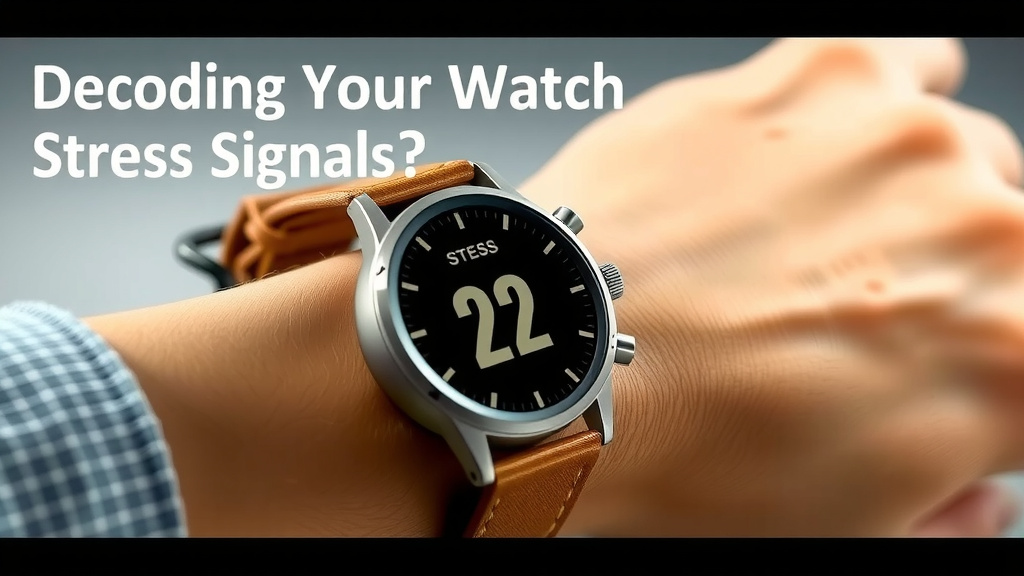
Other Physiological Clues Your Watch Might Track
While HRV and EDA are common, your smartwatch might also look at other bodily cues. These can provide a more rounded picture of your stress response.
Movement and Activity Levels
Sometimes, stress can lead to changes in your activity patterns. You might become more restless, or you might withdraw and become less active. Your smartwatch tracks your movement throughout the day. Sudden changes or periods of stillness when you’re usually active can be factored into the stress calculation.
Sleep Quality
Poor sleep is both a cause and a symptom of stress. Your smartwatch likely monitors your sleep cycles. If your sleep is consistently disturbed or you’re not getting enough deep sleep, this can contribute to a higher stress score. Many experts at the National Institutes of Health (NIH) point to sleep’s critical role in stress management.
Breathing Rate
Stress often causes shallow, rapid breathing. Some advanced smartwatches can monitor your breathing rate. Changes in your breathing patterns can be another signal that your body is under strain.
Putting It All Together: The Stress Score
Your smartwatch doesn’t just look at one signal in isolation. Instead, it uses sophisticated algorithms to analyze all this data together. It looks for patterns and correlations between your heart rate, HRV, EDA, activity, and sleep.
How Algorithms Work
These algorithms are trained on large datasets. They learn to associate certain combinations of physiological readings with stress. When your smartwatch detects a pattern that commonly occurs during stressful periods, it can assign a higher stress score. It’s like a detective piecing together clues to solve a case.
What Your Score Means
The resulting stress score is usually presented on a scale. For example, it might be a number from 0 to 100, or categories like “low,” “medium,” and “high.” It’s meant to give you a general idea of your body’s stress response throughout the day. We found that this can be a helpful tool for self-awareness.
Here’s a quick checklist of what your watch is measuring:
- Heart rate and its variability (HRV)
- Skin electrical conductivity (EDA)
- Your daily movement and activity
- Your sleep duration and quality
- Breathing patterns (on some models)
It’s important to remember that this score is an estimate. Your smartwatch is giving you a physical reading, not a mental health diagnosis. Factors like exercise, caffeine, and even the temperature can influence these readings. Think of it as a helpful nudge to check in with yourself.
“`Conclusion
Your smartwatch is more than just a timepiece; it’s a sophisticated tool for understanding your body’s stress signals. By monitoring subtle changes in your heart rate variability and skin conductance, it provides a stress score that can boost your self-awareness. Remember, this score is a guide, not a diagnosis. Use this information to check in with yourself and make small adjustments to manage your day better. Your journey to better stress management starts with understanding these cues.
Frequently Asked Questions
Can my smartwatch tell me exactly *why* I’m stressed?
No, your smartwatch cannot determine the specific cause of your stress. It measures physiological responses like heart rate variability and skin conductance, which are linked to stress. It can indicate *that* your body is experiencing stress, but not the reason behind it.
Is a low stress score always good?
Generally, a lower stress score suggests your body is in a more relaxed state. However, consistently low scores could sometimes indicate that your body isn’t responding as effectively to challenges. It’s best to look at trends over time rather than focusing on a single score.
Why does my stress score change so much throughout the day?
Your stress score fluctuates because your body is constantly reacting to internal and external stimuli. Activities like exercise, caffeine intake, meetings, and even conversations can influence your physiological signals. Your smartwatch captures these real-time changes.
Can factors other than stress affect my smartwatch’s stress readings?
Yes, absolutely. Physical exertion, illness, alcohol consumption, and even environmental changes like temperature can affect metrics like heart rate and skin conductance. Your smartwatch provides an estimate based on these readings, so it’s not a perfect measure of stress alone.
How accurate are smartwatches at measuring stress?
Smartwatches use advanced sensors and algorithms to provide a good estimate of your body’s stress response. While they are becoming increasingly sophisticated, they are not medical devices and should not be used for diagnosis. They are best used as tools for awareness and general well-being.
![7 Best Smart Watch 4g [2026]](https://smartwatchbest.com/wp-content/uploads/2026/08/7-best-smart-watch-4g-2026-featured-768x432.jpg)